29 January 2014

How to Teach Your Students Not to Kill People

It's not really like this.
Whenever people start talking about "competency-based outcomes" in higher ed, I think about Randy.  A couple of years ago, he and I shared a lab table in an anatomy and physiology class.  Both of us were the oldest participants in the class, 40-somethings working through life changes, but there our experiences diverged.  Where I was a college literature instructor filling in gaps in my science background and contemplating a shift from one professional career to another, Randy was going through the college for the first time, having come to a dead end in his job as a locksmith. During a lull Randy got to griping (as college students will) about the general education courses required for his degree, which he saw largely as a waste of time.  “I’m interested in the classes that will keep me from killing people,” he said. 

I didn’t do a particularly good job of persuading Randy that his required humanities courses would, also, fulfill that function, but I’m convinced that they can.  A life can depend on a health care provider’s ability to think flexibly: to understand what’s not being said as well as what is, to cope with unanticipated contingencies, to quickly take on board new forms of information, to reconcile incompatible expectations, to understand nuances, to communicate complicated facts; to recognize and work around the ways that gender, race, ethnicity, class complicate interactions between patients and providers.  These are skills that the humanities disciplines can teach.   

But how often does that actually happen? 

26 January 2014

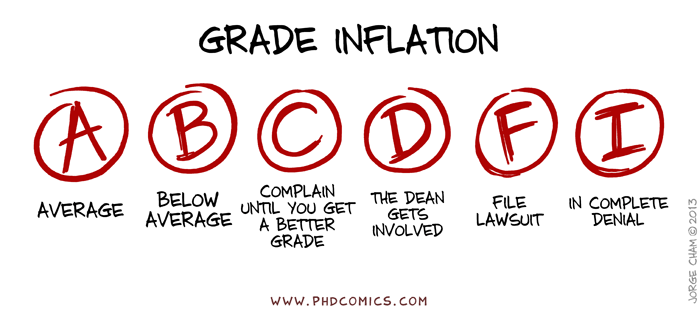
Sure, My Grades are Inflated. Got a Problem with That?


The first assignment of the semester always generates cries of dismay.  I use the full range of numbers available to me in my grading rubric and most students earn scores that, if they were correlated to a conventional letter grading scale, would end up being a high D or low C.  "Pay no attention to what the letter grade would be!" I exhort them.  "The grading rubric is a guide to help you build on your strengths and recognize your weaknesses--it's a tool, not a label of your worth as a student and human being.  Let the numbers guide you as you rewrite the paper, and you'll do much better on the next version."

And then I reassure them, "the way the grading usually works in my classes is, you do everything you need to do and show up to class regularly, you'll get some kind of B.  Put some muscle into and get interested and you'll get some kind of A.  People usually only get C's or lower if they miss a lot of classes, hand in papers later, and pass up opportunities to revise their work."  I mean it because it's true: that's how my grades usually work out.  Students rewrite a lot of papers, they do a lot of talking and interacting in class, they become better thinkers and writers, and  I end up giving out a lot of A's when the final grades come out.

If I could come up with a good reason why the world would be a better place if I gave out more C's and D's, I would do so.  But I can't.

25 January 2014

Adjunct Spackle

"A 'long-term fiscal crisis' has crushed Ph.D.s into adjunct spackle, to be applied liberally to cracks in university foundations."  --Tressie McCottom

Anyone concerned about adjunct issues and looking for reasons to spend time online yesterday (instead of, say, grading papers) found them:

Days like yesterday, it feels like higher ed could change.

What replaces "adjunct spackle" though?

Huge classes taught exclusively by tenure-stream faculty?

Mechanized teaching (not the same thing as online teaching, which is labor-intensive if done well)?

Eroded gen. ed requirements?

Adjunct activism needs to take place alongside activism about college teaching, and about what it looks like when it's done right.


23 January 2014

Because this is what the humanities look like....

This is not my life, but throw a rock into undergraduate higher ed and it will hit a classroom where this is the reality lived by the person running the class--this responsiveness to students squeezed into the interstices of life, this lack of resources, this desperation, this self-doubt:
... I continue to do the best possible job I can in the classroom, and increasingly, out of it: as any teacher will tell you, nowadays you can almost never leave your job in the classroom, or your office (if you’re lucky enough to have one), or the library or cafeteria, which are, as an adjunct instructor, the two places I usually meet my students—my “office hours.” As an instructor at three separate colleges, I maintain three separate emails, which I have to check at least twice a day, even on the weekends. I won’t go into the amount of hours I spend grading essays, but I will say that I spend at least 10-15 minutes on each essay I grade—sometimes longer, depending on how much help the student needs—and I have 142 students, who each write between 4-6 essays each semester. You can do the math. They are graded after my son falls asleep; they are graded before he wakes up; they are graded while I eat lunch; they are graded, in bits and pieces, while my students do a freewrite; they are graded in the single adjunct lounge with its single, barely working,

"You can rent the books from the library for free!"

Several times now I've heard students use the phrase "rent books from the library," by which they mean, of course, "borrow books...."  Yet they say "rent."  A mere adaptation of language, or a chilling symptom of What's Wrong with Everything?

22 January 2014

Before You Link to that IHE Article about the Success of Liberal Arts Grads...

"Liberal Arts Grads Win Long-Term" trumpets Inside Higher Ed. According to the front page of the website today, "Over the arc of a career, humanities and social science graduates earn as much or more than those in professional fields, new study shows, and are equally employed."

Except it doesn't and they don't (and aren't).

You don't even have click on short version of the study that the article is reporting (much less pay $20 to download a copy of the whole thing).  The information is right there in the article:

Liberal arts graduates don’t fare quite as well when they possess just an undergraduate degree, though. The workers with advanced degrees in any field of study – who make up about 40 percent of all liberal arts graduates, and earn about $20,000 a year more for it -- push the earnings averages up significantly. Among graduates with a baccalaureate degree only, those with humanities and social sciences degrees consistently earn less than anyone else, peaking at about $58,000 a year.
Got that?  Liberal arts graduates who go on to further study do better than non-liberal arts graduates. Liberal arts graduates who make their way through life solely on the basis of that BA/BS "consistently earn less than anyone else."  Isn't that pretty much what everyone thinks anyway?  And now there's a study to back it up.

There are good arguments to be made for the value of a liberal arts undergraduate degree. Misleading headlines like this one undermine them all.


Everyone Talks!

By Imranul Haque, shadow_lit AT yahoo.com (Own work)
 [GFDL (http://www.gnu.org/copyleft/fdl.html)], via Wikimedia Commons
My teaching goal for this semester is to get everyone talking.  Everyone.  I'm not teaching any new preps, I'm not trying out any bold new teaching formats, I'm mostly teaching texts I've taught at least once before, and so I'm focussing my energy on hearing from every student, every class (within reason).

I've already failed, but that's kind of how it goes. More on that below.

Some things I've tried before that have worked (I just need to do them more, and more consistently):